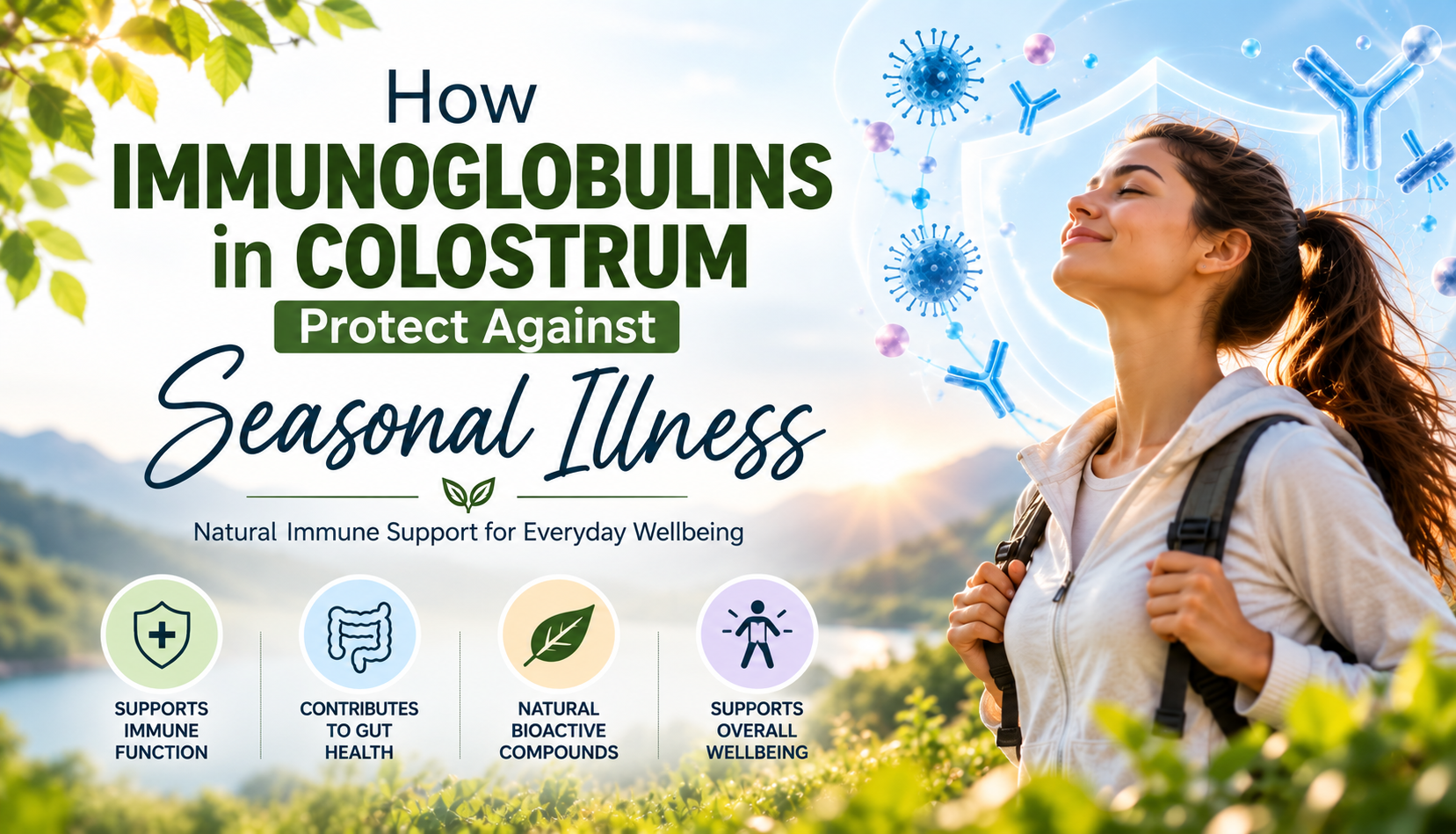
Colostrum is the first form of milk produced by mammals after birth. It has a distinctive nutritional composition and contains proteins, antibodies, growth factors, vitamins and minerals. Among its most studied components are immunoglobulins in colostrum, which play an important role in the early immune development of newborns.
Bovine colostrum, produced by freshly calved cows, is particularly rich in immunoglobulins. Although much of the biological importance of colostrum relates to newborn calves, researchers have also investigated whether colostrum supplementation may have relevance for human adults.
Understanding colostrum quality, antibody levels and the different types of immunoglobulin can provide useful context when considering how this naturally occurring food supports immune function.
Immunoglobulins in colostrum are proteins that form part of the body's immune defence system. They are commonly referred to as antibodies.
Colostrum contains much higher concentrations of immunoglobulins than mature milk. These proteins can interact with bacteria, viruses and other substances in the digestive tract.
In newborns, maternal antibodies provide temporary passive immunity while the developing immune system matures.
This is particularly important for newborn calves, which depend heavily on colostrum during the first hours of life.
Several types of immunoglobulin are found in colostrum.
Immunoglobulin G (IgG) is present in high concentrations in both bovine and human colostrum. In calves, IgG is particularly important for passive transfer following birth.
Immunoglobulin A, or IgA, is especially important within mucosal surfaces. Secretory IgA can create a local protective barrier within the gastrointestinal tract.
IgA is the most abundant antibody in human colostrum.
Immunoglobulin M (IgM) is another type of antibody involved in immune responses. It is commonly among the first antibodies produced following exposure to certain foreign substances.
Together, these immunoglobulins demonstrate why colostrum has such a distinctive immune-related composition.
For newborn animals, immunoglobulins provide immediate, temporary protection against various pathogens.
They can help bind or neutralise certain bacteria, viruses and toxins within the gut. Colostrum immunoglobulins also contribute to the development and maturation of the intestinal tract.
This process is known as passive transfer, where antibodies are transferred from the mother to the newborn.
The developing immune system can therefore receive maternal antibodies before its own immune responses are fully mature.
Colostrum management is particularly important for dairy calves because their ability to absorb antibodies decreases rapidly after birth.
Calves should receive colostrum during the first 6–12 hours of life, when absorption is most effective.
Common guidance discussed in calf nutrition includes feeding at least 10% of bodyweight in colostrum, while some recommendations suggest approximately 15% of birth weight within the first 12 hours.
Calves should receive colostrum within the first 24 hours because antibody absorption declines substantially with age. Some sources indicate that only a small proportion of antibodies may be absorbed after approximately 12 hours.
The exact feeding approach depends on calf management, nutritional needs and professional guidance.
Colostrum quality can be assessed using a Brix refractometer, an instrument used to estimate the concentration of dissolved solids.
A Brix reading of around 22% or higher is commonly used as an indicator of high-quality colostrum for calf management.
Factors affecting quality include:
The term high quality colostrum therefore relates not only to antibody concentration but also to appropriate collection and storage.
Colostrum can degrade relatively quickly after removal from the udder.
Poor storage or bacterial contamination can reduce its nutritional and immunological quality. For this reason, collecting colostrum and storing it correctly are important parts of colostrum management.
Freshly calved cows produce the first milking colostrum, which generally contains the highest concentrations of immunoglobulins.
Subsequent milkings gradually become more similar to mature milk.
One important function of colostrum immunoglobulins is their interaction with the digestive tract.
Secretory IgA can form a local barrier within the gut, while IgG and other proteins may interact with microbes and other substances present in the intestinal environment.
Research suggests that colostrum also contains growth factors and other bioactive proteins that contribute to the early development of intestinal tissues.
This is one reason the relationship between colostrum, the gut and immune function continues to receive research attention.
Interest in bovine colostrum supplementation has expanded beyond newborn animals.
Some studies involving adults have examined whether colostrum supplementation may influence immune-related markers during periods of physical stress. Research has also explored respiratory symptoms and other seasonal concerns.
However, evidence in adults remains developing, and results vary between studies.
It is therefore more appropriate to describe bovine colostrum as a nutritional source containing immunoglobulins and other bioactive compounds rather than making guaranteed claims about preventing or treating seasonal illness.
People experiencing symptoms such as a cough or sore throat should not rely on colostrum supplementation as a treatment.
Colostrum contains antibodies and proteins that have been investigated for their interaction with bacteria and viruses.
Some laboratory research has explored antiviral and antibacterial activity associated with colostrum components. Immunoglobulins may bind to specific microorganisms or their components.
However, laboratory findings do not necessarily predict what will happen after consuming a colostrum supplement.
Current research therefore supports continued investigation rather than definitive conclusions about seasonal infections in human adults.
The concentration of immunoglobulins can vary considerably between colostrum samples.
For calves, blood samples can sometimes be used to assess whether adequate passive transfer has occurred. This provides information about the calf's immune status following colostrum feeding.
In practical calf management, factors such as:
can all influence passive transfer.
The same principles should not automatically be applied to human supplementation, because humans and calves have different digestive and immune systems.
Not all colostrum has the same nutritional composition.
The first milking colostrum generally has a higher antibody concentration than milk collected later. Processing and storage can also affect the final product.
When evaluating colostrum supplements, information about source, processing, immunoglobulin concentration and quality control can therefore be useful.
The phrase gold colostrum is sometimes used informally to describe rich, concentrated first milk, but the actual composition should be evaluated using measurable characteristics rather than appearance alone.
In addition to immunoglobulins, colostrum contains growth factors and other bioactive proteins.
These compounds are involved in natural cellular and tissue processes during early development.
Research has explored growth factors in relation to intestinal development, tissue maintenance and other biological processes.
However, findings from animal or laboratory research should not automatically be interpreted as evidence of the same effects in human adults.
The relationship between immunoglobulins in colostrum and seasonal wellness is an evolving area of nutrition research.
Colostrum naturally provides antibodies, proteins and other nutrients that are important during early life. In newborn calves, timely access to high-quality colostrum is particularly important for passive transfer.
For human adults, research into colostrum supplementation is more limited. Some studies have examined immune markers and respiratory outcomes, but evidence remains mixed.
A balanced diet, sufficient sleep, regular physical activity, hydration and general healthy habits remain important parts of everyday wellbeing.
This article is intended for general educational and informational purposes only. It does not replace personalised advice from a qualified healthcare professional. Research into colostrum supplementation and its potential effects in human adults is ongoing, and individual nutritional needs and responses can vary.

Join The Hub community. Subscribe today and receive a monthly email with our newest blogs and articles on health, wellness, and nutrition to keep you informed and inspired.
By signing up you agree to our User Agreement and Privacy Policy & Cookie Statement


Newsletter
By signing up you agree to our User Agreement and Privacy Policy & Cookie Statement
By accessing, browsing, or using this website (the “www.newimage.world/thehub”), you acknowledge and agree to the terms of this Disclaimer. The Website, including its blogs, podcasts, videos, and any other content (collectively, the “Content”), is operated by New Image™ International (“the Company,” “we,” “our,” or “us”).
All Content made available on this Website is provided strictly for general informational and educational purposes only. The Content does not constitute, and should not be relied upon as, medical advice, diagnosis, treatment, prescription, or professional health consultation of any kind.
The Company makes no representations or warranties regarding the accuracy, completeness, reliability, or timeliness of the Content. The Content may include information collected from external or third-party sources, and we do not independently verify such information. Accordingly, no nutritional, health, or wellness claims are endorsed, warranted, or guaranteed by the Company.
To the fullest extent permitted by applicable law:
Your use of the Website does not establish any doctor–patient, nutritionist–client, or other professional relationship between you and the Company or any of its representatives.
The Website may include references, links, or access to third-party websites, podcasts, or resources. The Company does not control, endorse, or assume any responsibility for such third-party content and shall not be held liable for any damages arising from your use of or reliance on it.
By clicking “Accept” on the Website’s pop-up disclaimer, you expressly acknowledge that you have read, understood, and agreed to be bound by this Disclaimer. Your continued use of the Website constitutes ongoing acceptance of these terms. If you no longer agree with this Disclaimer, you must immediately discontinue use of the Website.
Join The Hub community. Subscribe today and receive a monthly email with our newest blogs and articles on health, wellness, and nutrition to keep you informed and inspired.
By signing up you agree to our User Agreement and Privacy Policy & Cookie Statement













.webp)
.webp)